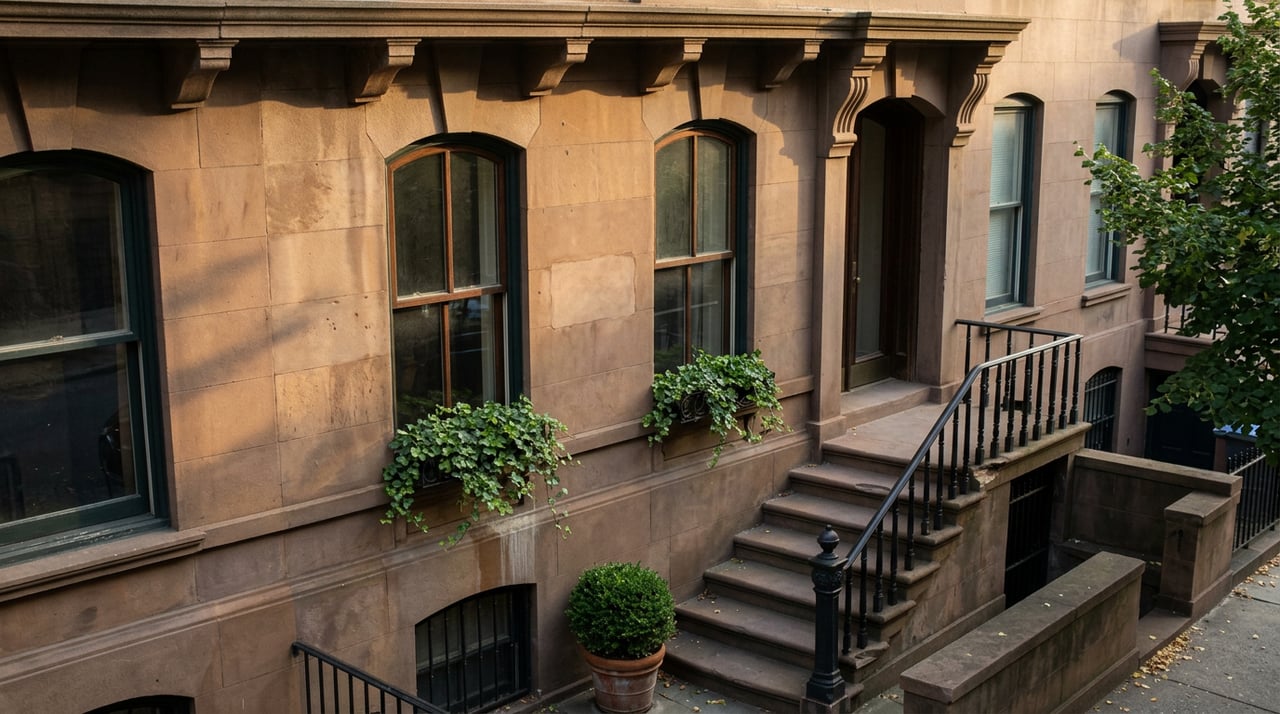
The Brownstone Premium Nobody Prices Correctly
September 10, 2026
September 10, 2026
You've found the house. Three stories, original moldings, a garden level with rental potential, priced right for the block. Your agent mentions it sits inside a historic district. You nod, file that under "charming detail," and move on to inspection scheduling.
That's the moment most Brooklyn brownstone buyers get the story backward. Landmark status isn't a charm detail. It's a sequencing problem that can decide whether your renovation happens on the timeline you budgeted for, and it's baked into the price spread between two brownstones that look nearly identical on paper.
Landmark status in Brooklyn isn't one uniform overlay. It's a patchwork of individually designated historic districts, each with its own boundaries and its own designation date, and most of the borough's classic brownstone stock sits inside one of them.
Brooklyn Heights was first: designated November 23, 1965, the earliest historic district in New York City, bounded by Cadman Plaza West, the Brooklyn-Queens Expressway, Atlantic Avenue, and an irregular line following Clinton and Henry Streets. Fort Greene followed in 1978, centered on the 33-acre park Frederick Law Olmsted and Calvert Vaux redesigned in 1867, and it includes the Brooklyn Academy of Music. Bed-Stuy carries two separate districts rather than one: an original district established in 1971 south of Fulton Street, and a larger district designated in 2015 covering more than 800 buildings on the neighborhood's western side. Park Slope, Cobble Hill, Boerum Hill, and Clinton Hill each carry their own district boundaries as well.
The point isn't the trivia. It's that "is this house landmarked" is a yes-or-no question with a genuinely different answer block by block, and the district a house sits in determines which local body reviews your renovation before the Landmarks Preservation Commission does.
Here's the mechanism that catches buyers off guard: LPC review typically happens before the Department of Buildings issues a permit, not after. A buyer who plans a kitchen expansion or a rear addition and assumes DOB approval is the finish line often discovers that DOB won't move until LPC signs off first, even for work that wouldn't otherwise require a DOB permit at all.
LPC actually runs two separate approval tracks, and which one your project falls into matters more than whether the house is landmarked in the first place.
| Track | What it covers | Typical timeline |
|---|---|---|
| Certificate of No Effect | Work that requires a DOB permit but doesn't affect protected features (mechanical equipment, some interior-driven exterior touches) | Staff-level review, often decided in about 10 business days, with a legal deadline of 30 business days after the application is deemed complete |
| Certificate of Appropriateness | Work that touches significant protected features or doesn't conform to LPC's rules for the district (facade changes, new windows, stoop work) | A full public hearing cycle, typically 3 to 6 months |
The gap between those two tracks is the entire renovation timeline for most buyers. A rear extension that reads as a minor addition to the owner can land in the Certificate of Appropriateness lane simply because it's visible from a neighboring yard or an upper-floor window, since LPC treats that kind of visibility as public view even when the space itself is private.
There's a second friction point that sits between the buyer and LPC, and it's local government, not the Commission itself: the community board. In several Brooklyn districts, an applicant has to present the renovation to the community board's land use or landmarks committee, and in some neighborhoods, secure a letter of support from a neighborhood preservation group, before LPC's own public hearing ever happens.
Brooklyn's Community District 2 alone contains 10 of the borough's 41 historic districts, which gives a sense of how much of this review volume runs through community boards rather than LPC directly. Applicants in some districts must also notify abutting neighbors in writing, post notice on the block for at least seven days before a hearing, and contact the local block association, all before the case reaches LPC's calendar.
Timing adds one more wrinkle worth knowing before you write an offer with a renovation-dependent closing date: Brooklyn's community boards typically observe summer recess in July and August and don't review private residential applications during those months. A buyer who closes in June expecting to break ground by August can lose two months before a hearing even gets scheduled.
This is where the sequencing risk shows up in dollars. In one comparison from February 2026, a renovated four-story brownstone in Park Slope closed at $4.85 million while a comparable fixer-upper in Bed-Stuy closed at $1.35 million the same month, a spread of roughly $3.5 million across a few subway stops. Neighborhood cachet explains part of that gap. But so does the fact that the Bed-Stuy price already discounts the approval-and-construction runway a buyer is about to take on, a runway that runs longer and carries more procedural steps in a landmarked district than most listing sheets communicate.
Landmarked renovation work also carries a real cost premium once you clear the approval stage. Facade restoration alone commonly runs $30,000 to $80,000 depending on condition, and a landmarked renovation typically costs 15 to 25 percent more than a comparable non-landmarked project, driven by required historic materials like custom wood windows and matched masonry rather than the cheaper modern equivalent. LPC filing preparation itself, separate from construction, typically adds $2,000 to $8,000 in fees and four to twelve weeks to the schedule before exterior work can even start.
None of this means landmark status is a liability to price around. It cuts the other way too: because LPC prevents neighboring buildings from making changes that would diminish a block's architectural character, landmarked brownstones often hold their value better during market downturns, and Park Slope's median sale price reached $1.8 million in the second quarter of 2026, up 21.3 percent year over year, even as overall transaction volume in the neighborhood pulled back. The prime row-house belt, spanning Park Slope, Cobble Hill, Brooklyn Heights, Boerum Hill, and Carroll Gardens, traded between $1.4 million and $3 million in spring 2026, with restored single-family product clearing $4 million or more in tight blocks. That's a market that rewards patience with the approval process, not one that punishes landmark status outright.
A few questions answered before contract can save months of surprise later:
Is my brownstone automatically landmarked because it's old? No. Age alone doesn't create LPC jurisdiction. The building has to sit inside a designated historic district or carry an individual landmark designation, which you can confirm against the district's official boundary.
Does landmark status hurt resale value? Generally not. It protects the block's architectural character by preventing neighboring alterations that would diminish it, which is part of why landmarked brownstones often hold value through downturns better than comparable non-landmarked stock.
Can I avoid LPC entirely with an interior-only renovation? Often yes, but not always. Interior work generally stays outside LPC's jurisdiction unless it requires a DOB permit, touches the exterior in any way, such as a rear window relocation or a rooftop mechanical vent, or the building carries a rare individual interior landmark designation, which is uncommon for residential brownstones.
Brownstone Brooklyn rewards buyers who understand the sequence, not just the block. If you're comparing landmarked inventory against non-landmarked stock and want a read on what a specific renovation plan would actually cost in time and approval steps, Jillian Abbadessa Real Estate can walk through it with you. Let's Connect.
Stay up to date on the latest real estate trends.

Experience a higher level of service defined by data-driven strategy, global reach, and personalized guidance.